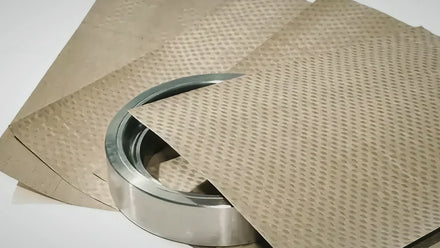
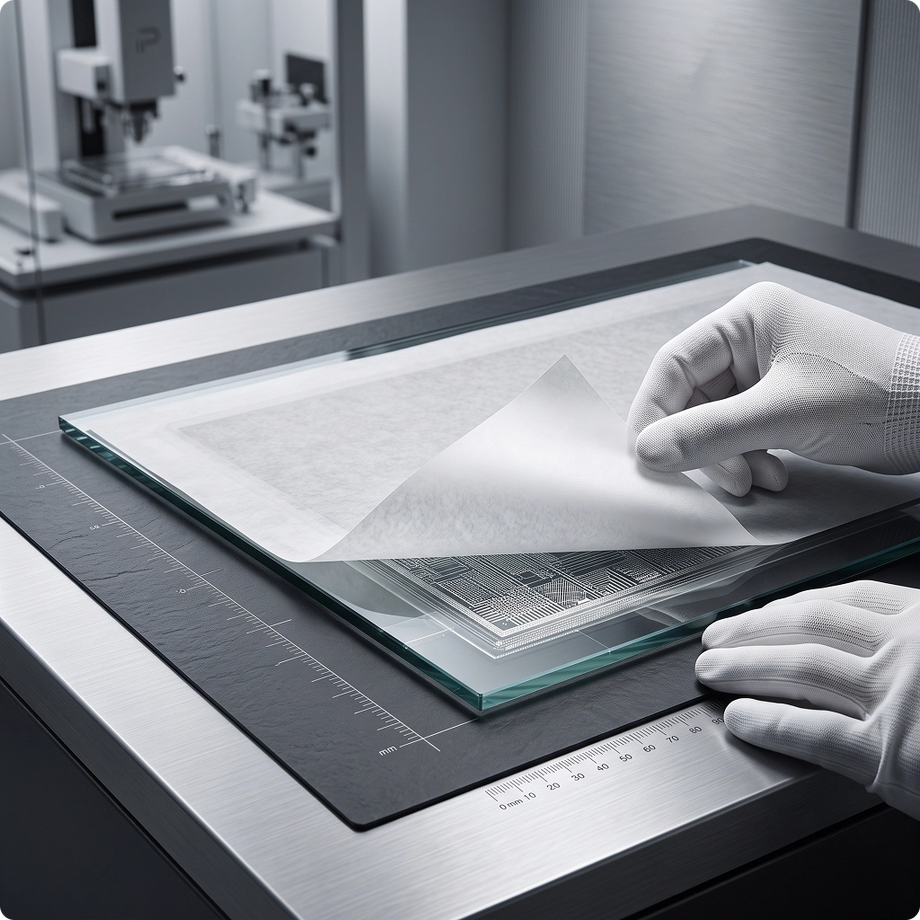
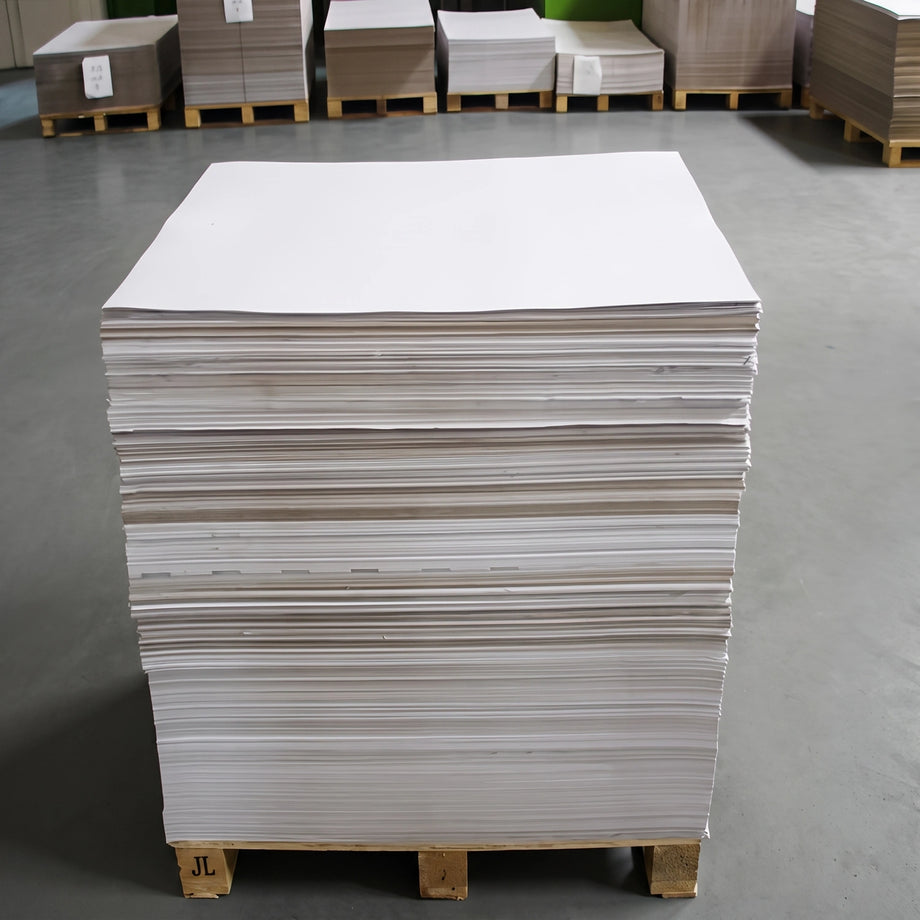
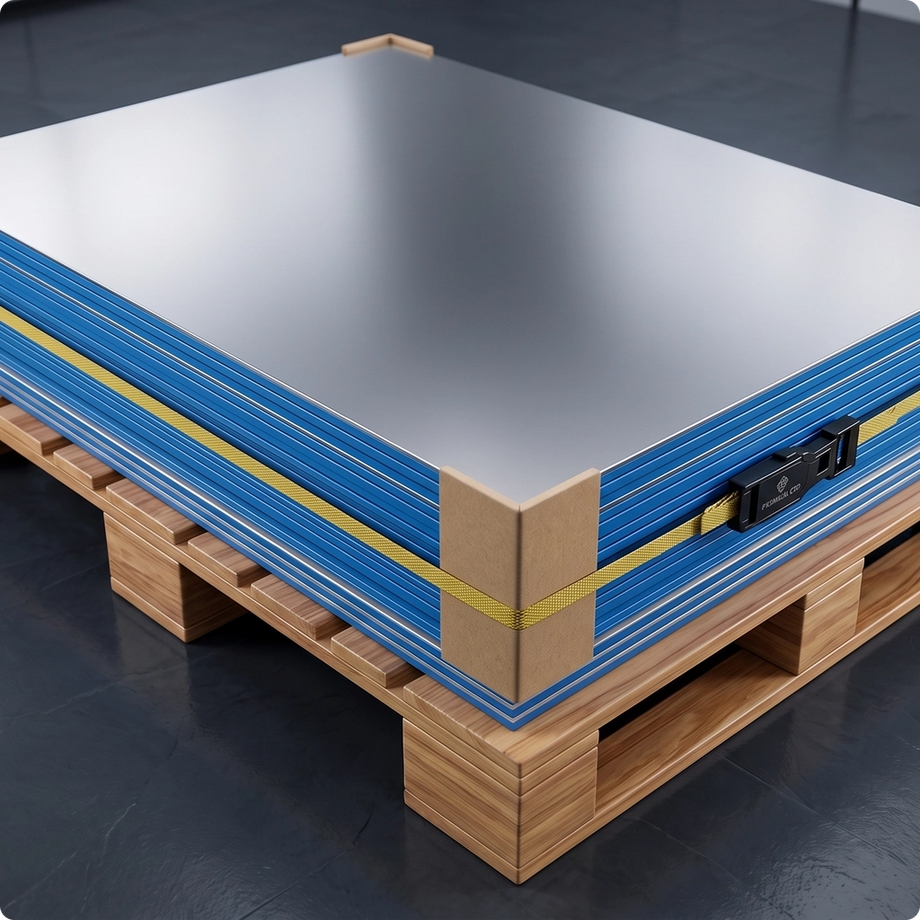
Glass interleaving paper for LCD substrates is a thin, clean paper, cut to sheets or slit to reels, laid between stacked display glass so panels do not scratch, pick up particles or stick together. Specify the fibre, no hard fillers or silicone additives, basis weight, moisture, surface resistance and a particle count, then prove the grade in a stacking trial.
Key takeaways
- On display glass, the paper's main risks are hard particles, organic residues and static, not alkali staining.
- Turn each risk into a specification line with a value, a tolerance and a named test method.
- Give pH, chloride and sulphate a number, a method and an extraction.
- Decide on a grade only after a stacking trial on your own glass and handling line.
What does glass interleaving paper do between LCD substrates?
It protects each sheet of display glass by keeping it from touching the next, without leaving anything behind. Glass interleaving paper has four jobs in a stack of LCD or OLED substrates:
- Separation. It stops glass-to-glass contact, which causes scratches and chips at the edges.
- Cushioning. It absorbs some of the vibration a stack sees on the road, at sea and in handling.
- Cleanliness. It must not transfer particles, fibres or organic residues to a surface that will later go through thin-film deposition and photolithography.
- Release. It must let a vacuum pick-up or robot lift one sheet of glass, or one sheet of paper, at a time.
Kaifeng Paper lists an LCD Substrate Protection Paper for this job. Its product page says moisture and electrical conductivity are controlled to help vacuum loaders separate panels, and that a fibre-binding treatment keeps lint low. The page lists the grade at 50 g/m² and 75 µm; the full list of published values is in Table 3.
How do storage risks differ for display glass and building glass?
The storage problem every glass handler knows is staining. Pilkington explains that water trapped between stored lites reacts with the glass and forms an increasingly alkaline solution, which attacks the surface and leaves haze and roughness [1]. Repeated wetting and drying makes it worse, so Pilkington advises storing glass in conditions where daytime relative humidity stays at 70% or less, and never above 80% [2].
Display substrates are a different material. AGC, for example, describes its AN100 substrate for TFT-LCD and OLED displays as an alkali-free aluminosilicate glass [3]. With little alkali to leach, the staining Pilkington describes is a smaller concern than it is for soda-lime building glass, and the paper's job shifts to three things a panel line cannot easily clean away: hard particles, organic films and static.
Table 1. What the interleaving paper must control, by glass type
| Glass type | Main storage risk | What the paper must control |
|---|---|---|
| Soda-lime float glass (building, automotive) | Water and alkali staining, scratches | Moisture handling, spacing, abrasion |
| Display substrates (LCD, OLED) | Particles, organic residues, static, scratches | Hard particles, extractives, moisture range, surface resistance |
| Cover and optical glass | Scratches, particles | Hard particles, fibre shedding, surface smoothness |
Storage climate still matters for display glass, because humidity changes the paper's moisture, static behaviour and flatness. Pilkington also advises that glass taken out of its case is always stored with interleaving or spacing between individual lites [2]. Ask your paper supplier which storage temperature and relative humidity it recommends for its packs.
Buying interleaving paper for display glass?
Send your glass size, basis weight, sheet or reel format and monthly volume. We quote LCD glass interleaving paper for your stacks.
Interleaving papers from Kaifeng
Which paper defects turn into glass defects?
Three paper defects matter most on display glass: hard particles, organic residues and the wrong moisture level. Table 2 links each one to the glass defect it can cause and to a line in the specification.
Table 2. Paper defects and what they do to display glass
| Paper defect | What can appear on the glass | What to specify |
|---|---|---|
| Hard particles (sand, rust flakes, mineral fillers) | Scratches during transport vibration | No mineral fillers, virgin pulp, dirt count, ash |
| Silicone or wood resin residues | Organic film that water rinsing does not remove | No silicone-based additives, solvent extractives limit |
| Loose fibres and dust | Particles on the surface before deposition | Surface strength, dirt count, edge quality |
| Moisture too low | Static, sheets sticking, double picks | Moisture range, surface resistance |
| Moisture too high | Water carried to the glass, curl, poor flatness | Moisture range, storage climate |
| Soluble salts, extreme pH | Residues on the surface | pH, conductivity, chloride and sulphate with methods |
Hard particles and scratches
A particle harder than glass, trapped between the paper and the substrate, can scratch it once the stack starts to vibrate. Sand, rust flakes and hard mineral fillers are typical examples, and they can enter paper with the pulp, the process water or recycled fibre.
Write three lines into the specification. First, no mineral fillers and no recycled fibre. Second, a dirt count with an agreed method: TAPPI T 437 estimates dirt in paper visually, as equivalent black area, and TAPPI T 563 is the instrumental method using image analysis [4]. Third, an ash limit: ISO 2144 measures the residue on ignition at 900 °C [5]. Low ash does not rule out a single hard particle, which is why the stacking trial still matters.
Organic residues from silicone and wood resin
Silicone-based defoamers used in pulp washing and natural wood resins can transfer from paper to glass as a thin organic film. A film like this is not easy to rinse off with water, and it can interfere with later coating and patterning steps on the substrate.
Ask the supplier to state in writing whether any silicone-based additives are used in the grade, and agree a limit and a test method for solvent extractives.
Static, moisture and stuck sheets
Paper that is too dry builds static, so sheets cling to the glass and a vacuum pick-up can lift two at once or tear the paper. Paper that is too wet loses flatness and brings water to the glass. Specify a moisture range measured to ISO 287 [5] and a surface resistance range, with the method named. Kaifeng lists moisture below 6.0% for its LCD grade, and a wetting expansion rate of no more than 3.5% in the cross direction, which describes how much the sheet changes size when wetted. IEC 61340-2-3 describes resistance tests for solid materials used to avoid electrostatic charge accumulation, for measured resistance from 10 kΩ to 1 TΩ, that is 10⁴ to 10¹² Ω [6]; if the paper sits above that range, agree another method with the supplier.
What about pH, chloride and sulphate?
Display glass makers usually ask for a near-neutral paper with low soluble salts. The rule is the same as for interleaving paper for stainless steel coils: give each limit a number, a test method and the extraction used. For pH, ISO 6588-1 is the cold-extraction method [5]; hot extraction is also used, so state which one your limit refers to. Kaifeng's product page lists its LCD grade at pH 6 ± 1.0 and an electrical conductivity below 30 µS/cm, which gives a first view of total soluble salts. For individual ions, ask each supplier for chloride and sulphate figures with the test method and the detection limit.
How heavy should the paper be, and sheets or reels?
Choose basis weight by glass thickness, sheet size and how the stack is built and handled. Lighter paper adds less stack height and costs less per square metre; heavier paper cushions better and is less likely to be pulled through by a vacuum cup. Agree a basis weight with a tolerance, and thickness as well, because two papers of the same weight can differ in thickness. Kaifeng lists its LCD grade at 50 g/m² ± 5% and 75 µm ± 5, with tensile strength of at least 3.0 kN/m in the machine direction and 1.8 kN/m across it. If that weight does not suit your stack, ask which other basis weights the supplier can offer.
Sheets should be at least as large as the glass, so no edge of one substrate touches the next. Reels are slit to the width of an automatic paper feeder. Specify:
- sheet size and tolerance, or reel width, diameter and core;
- whether both sides of the paper are equivalent, or which side faces the glass;
- joints allowed per reel and how they are marked;
- wrapping that keeps reels and sheet packs dry and clean until use.
What should a glass interleaving paper specification include?
Every property needs a value, a tolerance or maximum, and a method agreed with the supplier. Table 3 is a template; the third column shows the values Kaifeng lists on its LCD product page as an example, and "Not listed" marks values to agree with your supplier. The ISO paper test methods in the last column appear in the Cepi-CTS list of paper test methods [5].
Table 3. Glass interleaving paper specification template
| Property | Why it matters for display glass | Example (Kaifeng LCD grade, product page) | Method to agree |
|---|---|---|---|
| Fibre and fillers | Hard particles | Not listed | Supplier declaration |
| Silicone-based additives | Organic film | Not listed | Supplier declaration |
| Basis weight | Cushioning, stack height | 50 g/m² ± 5% | ISO 536 |
| Thickness | Stack height, cushioning | 75 µm ± 5 | ISO 534 |
| Moisture | Static, flatness | < 6.0% | ISO 287 |
| Tensile, MD / CD | Feeding, handling | ≥ 3.0 / ≥ 1.8 kN/m | ISO 1924-2 |
| Tear, MD / CD | Edge damage | ≥ 300 / ≥ 350 mN | ISO 1974 |
| Wetting expansion, CD | Flatness in humid storage | ≤ 3.5% | Agreed |
| Water absorption (Cobb) | Moisture uptake | ≥ 30 g/m² | ISO 535 |
| Surface resistance | Static, picking | Not listed | IEC 61340-2-3 or agreed |
| Dirt count | Particles, scratches | Dustiness 0 per m² | TAPPI T 437, T 563 or agreed |
| Ash | Mineral content | Not listed | ISO 2144 |
| Solvent extractives | Organic residues | Not listed | Agreed method |
| pH, aqueous extract | Surface residues | 6 ± 1.0 | ISO 6588-1 (cold) or a hot extraction method |
| Conductivity, aqueous extract | Total soluble salts | < 30 µS/cm | Agreed, with extraction method |
| Brightness (D65) | Visual inspection contrast | ≥ 80% | ISO 2470-2 or agreed |
| Chloride, sulphate | Surface residues | Not listed | Agreed, with detection limit |
| Format | Coverage, feeding | Not listed | Drawing |
The product page does not name its test methods and invites buyers to request the full technical data sheet with a quote. Ask for it, and check that each value comes with a method and a unit.
Questions to send with your RFQ
- Which test method stands behind each value on the data sheet?
- Which method, smallest speck size and inspection area stand behind the dirt count?
- What surface resistance does the grade reach, and by which method?
- Which extraction is used for pH, and what are the chloride and sulphate maximums?
- Are any silicone-based additives, mineral fillers or recycled fibre used in the grade?
- Which sheet sizes, reel widths and cores can you supply?
How do glass makers qualify a new interleaving paper?
Qualify the paper on your own glass, in your own stack, under your own transport conditions. A data sheet cannot show whether a rare hard particle will reach the glass.
- Check documents. Compare the certificate of analysis with the specification, including methods and units.
- Run a stacking and vibration trial. Interleave the candidate paper with production glass, pack it the way you ship, and run a vibration or transport simulation agreed with your customer. Then inspect both faces of every sheet under inspection lighting and a microscope.
- Trace any defect. Analyse particles found at scratch sites to tell paper-borne material from glass chips or packaging debris.
- Run the handling line. Check vacuum pick-up, paper removal and stacking on the actual equipment.
- Ship a pilot lot. Follow it to the customer, and check that lots stay consistent, before switching volume.
Keep packs closed until use and store them in conditions that avoid condensation, as Pilkington advises for the glass itself [2]. Before the trial, agree with the supplier how much trial paper you need and what its certificate of analysis will show.
What should an enquiry for glass interleaving paper include?
Your glass, your handling line and the specification lines above. A supplier who answers each line with figures and methods is easier to qualify than one who sends a brochure.
- Glass type, thickness, sheet size and substrates per stack
- Format: sheet size and tolerance, or reel width, diameter, core and joints
- Basis weight, thickness, moisture and surface resistance, each with a tolerance and method
- Dirt count, ash, and a written statement on fillers, recycled fibre and silicone-based additives
- pH with the extraction method, conductivity, and chloride and sulphate maximums
- Certificate of analysis contents, monthly volume and delivery destination
Send your glass size and stacking method
Kaifeng lists its LCD grade among its industrial interleaving papers for glass, metal and printing plates. To compare a candidate grade with the paper you use now, send your glass size and stacking method.
- Tell us the glass size, thickness and how the stack is built.
- Add the basis weight, sheet or reel format and monthly volume.
- We quote LCD glass interleaving paper against that specification.
FAQs
What is interleaving paper?
Interleaving paper, also called interleaf or a separator sheet, is a thin paper placed between layers to protect a material that would otherwise scratch, mark or stick to itself. Glass, stainless steel coils and printing plates all use it; for plates, see what CTP plate interleaving paper does. For display glass, the paper is judged mainly on cleanliness: no hard particles, no silicone or resin residues, controlled moisture and controlled static.
What is glasspaper (glass paper) used for?
In British English, glasspaper, also written glass paper, is an abrasive sheet: paper coated with glass powder and rubbed on a surface to smooth it [7]. That is the opposite of what glass needs. Paper used to protect glass is normally called glass interleaving paper or interleaf. If you are buying for a glass line, use the full term with suppliers so that nobody quotes for an abrasive product.
What paper is used to wrap glass?
Industrial glass is not wrapped sheet by sheet. Paper is laid between the sheets in a stack as a separator, and the stack is packed in a case or rack to protect it in transport. For display substrates, that paper is a clean, virgin-fibre grade with controlled moisture and no hard fillers. General packing paper is not suitable, because it may carry recycled fibre, fillers or dust.
How much does glass interleaving paper cost?
Suppliers quote business customers by grade, basis weight, format and volume, so there is no list price. Compare offers per square metre rather than per tonne when grammages differ, and include the cost of rejected glass in the comparison.
Can glass interleaving paper be reused?
Display glass makers generally use fresh paper for every stack, because used sheets can carry particles, creases and moisture back to the glass and cause defects. Some building glass handlers reuse paper on less critical work after checking it. If you reuse any interleaf, set a written rule for inspecting it first and keep it out of display glass areas.
Is interleaving powder better than paper for glass?
They solve different problems. Some glass is stacked with a separating powder instead of paper, and the powder then has to be washed off before processing. On substrates that go on to thin-film processing, any residue is a risk, so check whether your customer's line accepts powder at all before you change method. Ask your customer which method its line accepts.
What core diameter do glass interleaving paper reels use?
There is no single core size for display glass lines. The core has to fit the unwind shaft of your automatic paper feeder, and the reel's outside diameter and weight have to suit how the feeder is loaded. Put the core inner diameter, the core material and the maximum outside diameter on your drawing, and ask the supplier which cores it can wind onto before you fix them.
Does LCD glass interleaving paper need to be anti-static?
It needs controlled static, not the lowest possible value, because both too much and too little moisture can cause handling faults. Specify a consistent moisture range and a surface resistance range with named methods, condition samples before testing, and confirm the result on your own vacuum pick-up equipment. Paper that is too dry clings to glass; paper that is too wet loses flatness and brings water to the surface.
Compliance note: requirements for interleaving paper are set by the glass maker's or panel maker's specification. Parameters for Kaifeng grades are subject to Kaifeng's current specification sheets and test reports.
Sources
- Pilkington North America. "ATS-104 Protecting Flat Glass Surfaces". Pilkington, 2025. https://www.pilkington.com/-/media/pilkington/site-content/usa/window-manufacturers/technical-bulletins/ats-104---protecting-flat-glass-surfaces.pdf Accessed Nov 2026.
- Pilkington North America. "ATS-112 Preventing Moisture Stains on Stored Glass". Pilkington, 2026. https://www.pilkington.com/-/media/pilkingtonredesign/downloads/usa/architectural/technical-bulletins/ats-112---preventing-moisture-stains-on-stored-glass.pdf Accessed Nov 2026.
- AGC. "Glass Substrates for TFTs (AN100)". AGC, n.d. https://www.agc.com/en/products/display/detail/an100.html Accessed Nov 2026.
- TAPPI. "Dirt in paper and paperboard, Test Method TAPPI/ANSI T 437 om-25". TAPPI, 2025. https://imisrise.tappi.org/TAPPI/Products/01/T/0104T437.aspx Accessed Nov 2026.
- Cepi-CTS. "Handbook 5:1 List of properties for which samples are provided and their indicative ranges" (Rev. 45). Cepi, 2026. https://www.cepi.org/wp-content/uploads/2026/05/HB51-Properties-list.pdf Accessed Nov 2026.
- International Electrotechnical Commission. "IEC 61340-2-3:2016 Electrostatics — Part 2-3: Methods of test for determining the resistance and resistivity of solid materials used to avoid electrostatic charge accumulation". IEC, 2016. https://webstore.iec.ch/en/publication/25199 Accessed Nov 2026.
- Oxford Learner's Dictionaries. "glasspaper". Oxford University Press, n.d. https://www.oxfordlearnersdictionaries.com/definition/english/glasspaper Accessed Nov 2026.