Buy greaseproof paper sheets when staff wrap food by hand, and rolls when a machine wraps or you cut your own sizes. For a bulk order, state the sheet size or reel width, grammage, grease-resistance level and test method, and pack and pallet counts. Ask for food-contact and PFAS documents for the exact grade.
Key takeaways
- Choose the format by where the cutting happens: sheets for hand wrapping, slit reels for machines, jumbo rolls for converters.
- Give the sheet size in millimetres with a tolerance, and agree who pays for the trim.
- Specify grammage and grease resistance separately, each with a test method.
- Convert every quote to price per 1,000 sheets or per kilo before comparing.
Should a food business buy greaseproof paper as sheets or rolls?
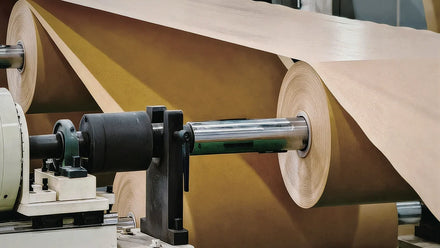
Buy sheets for counters where people wrap by hand, slit reels for wrapping and bagging machines, and jumbo rolls only if you or your converter will slit, sheet or print the paper. The real difference in a bulk order is where the cutting happens and who pays for the trim.
Table 1. Greaseproof paper formats for bulk buyers
| Format | Who usually buys it | What to specify | Advantage | Trade-off |
|---|---|---|---|---|
| Cut sheets in packs | Takeaways, cafés, catering wholesalers | Sheet size and tolerance, sheets per pack, packs per carton | Ready to use at the counter | One fixed size; more packaging per kilo of paper |
| Cutter-box rolls | Kitchens, delis, bakeries | Width, length, core | Any length from one roll | Slower than a pre-cut sheet at a busy counter |
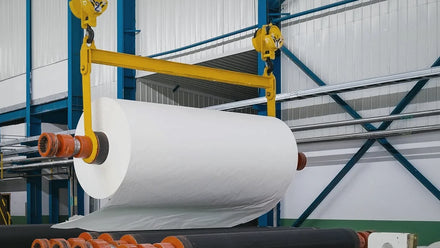
| Slit reels | Food producers with wrapping or bagging machines | Width, core inner diameter, outer diameter or length, joins per reel | Continuous feed for the machine | A new grade needs machine trials |
| Jumbo rolls | Converters and printers | Reel width, core, diameter, grammage tolerance | Usually the lowest cost per tonne | Needs slitting, sheeting or printing capacity |
Catering wholesalers often stock both sheets and cutter-box rolls. Buyers ordering by the pallet or container usually go further up the chain, to a converter for finished sheets or to a paper maker for reels.
Whichever format you buy, ask whether the supplier cuts the sheets or slits the reels itself or passes the paper to a converter, because that decides who holds the size tolerance and who answers for the trim.
Which greaseproof sheet sizes do UK food businesses use?
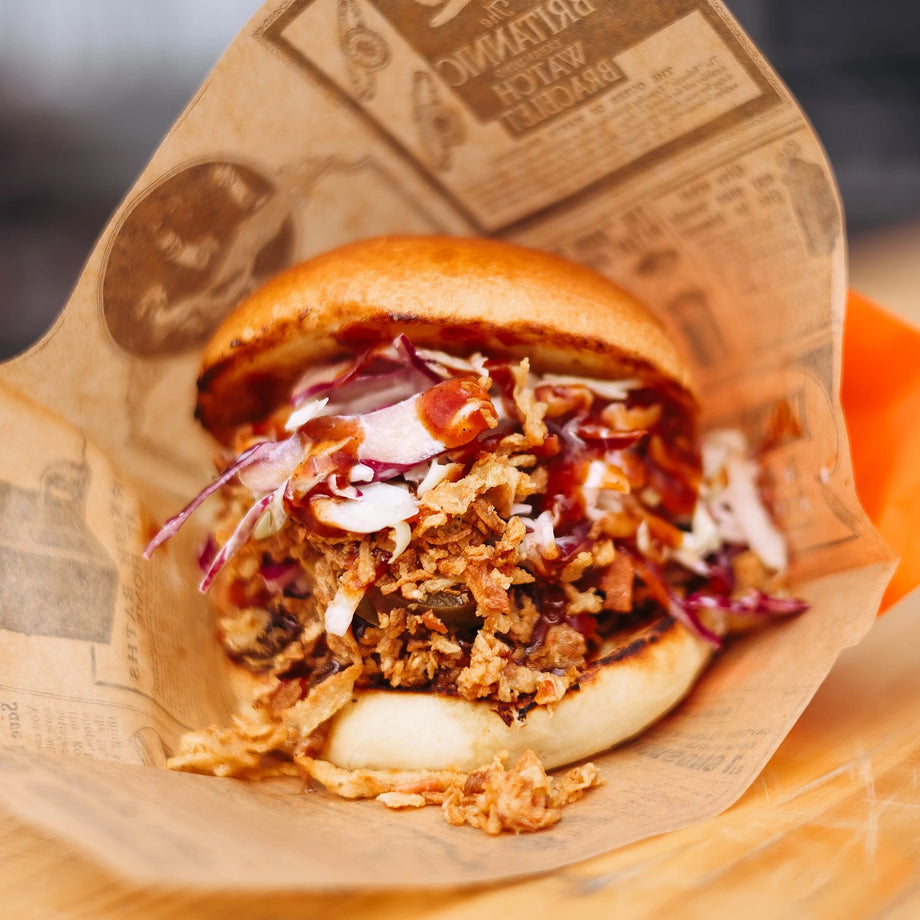
Set the sheet size by what the sheet wraps and how staff fold it, then give the size in millimetres with a tolerance when you ask for a quote. Smaller sheets go to burgers and sandwiches; larger ones to fish and chips, trays and big wraps.
Table 2. How to set a greaseproof sheet size for each use
| Use | What decides the size | What to state in the enquiry |
|---|---|---|
| Burger and sandwich wraps | Bun or bread size, filling height and the fold staff use | Size in mm, tolerance on each side, sheets per pack |
| Fish and chip wraps | Portion size, and whether an inner sheet goes inside an outer wrap | Size in mm and tolerance for each sheet |
| Tray and basket liners | Inside base of the tray or basket, and how far the sheet should come up the sides | Inside tray dimensions, size in mm, tolerance |
| Bakery and deli sheets | Product size, and whether the sheet is used to pick up, interleave or wrap | Size in mm, tolerance, sheets per pack |
| Sizes cut from a supplier's standard sheet | The parent sheet size and how many pieces it yields | Parent sheet size, pieces per sheet, who pays for the trim |
Some suppliers name sheet sizes after the office paper sizes A4 (210 × 297 mm) and A3 (297 × 420 mm). The names are familiar, but they come from office paper, not food wraps, so state the size in millimetres anyway.
Before ordering, ask the supplier:
- which sizes it cuts as standard, and the tolerance it holds on each side
- whether a size outside that list carries a separate minimum
- how many pieces your size yields from its parent sheet, and who pays for the trim
- how sheets are counted and packed, so that a pack of one size can be compared with another

Buying greaseproof sheets or reels in bulk?
Send your sheet size or reel width, grammage, pack count and annual volume. We quote per 1,000 sheets or per kilo.
What grammage should greaseproof paper sheets be?
Kaifeng's product page lists its greaseproof grade at 35–50 g/m². Grammage tells you weight, stiffness and sheets per kilo. It does not tell you how well the paper holds back fat.
Grammage is measured by the method in ISO 536 and reported in grams per square metre (Cepi-CTS HB 5:1). Agree a target and a tolerance in the order, because the tolerance changes how many sheets you receive per tonne.
Grease resistance needs its own line. In the TAPPI T 559 kit test, numbered test solutions are applied to the paper and the result is the highest-numbered solution the paper holds without failing (TAPPI T 559). Kaifeng's product page shows why the two need separate lines: it lists one grammage range, 35–50 g/m², with Kit 2–6 set to the customer's requirement, plus Cobb ≤ 28 g/m² and optical brightening agents negative. TAPPI also notes that the test was designed for fluorochemical treatments and that its use on papers with film-like barriers or other treatments has to be evaluated, so ask how the Kit figure was obtained for the grade you are buying.
Choose the grade with the food in mind. A dry pastry sheet and a wrap for a hot, fatty burger can share a grammage and still need different grease resistance, so test two or three grades with your fattiest product at your real holding time.
Questions to send with your RFQ
- Do you cut the sheets or slit the reels yourself, or pass the paper to a converter?
- What grammage target and tolerance do you hold for this grade?
- Which Kit result does this grade reach, and how was that figure obtained?
- Is there a third-party PFAS test report for this exact grade?
- Will every carton or reel label carry a lot number?
- Which documents come with the first delivery?
How many sheets are in a kilo, and how many metres are on a roll?
Use two formulas to turn any quote into comparable units:
- Sheets per kilo = 1,000 ÷ (grammage in g/m² × sheet area in m²)
- Roll length in metres = roll weight in kg × 1,000 ÷ (grammage in g/m² × width in m)
Table 3. Theoretical sheets per kilo, and kilos per 1,000 sheets
| Sheet size (mm) | 35 g/m² | 38 g/m² | 40 g/m² | 45 g/m² | 50 g/m² |
|---|---|---|---|---|---|
| 500 × 335 | 171 / 5.86 kg | 157 / 6.37 kg | 149 / 6.70 kg | 133 / 7.54 kg | 119 / 8.38 kg |
| 420 × 297 | 229 / 4.37 kg | 211 / 4.74 kg | 200 / 4.99 kg | 178 / 5.61 kg | 160 / 6.24 kg |
| 406 × 255 | 276 / 3.62 kg | 254 / 3.93 kg | 241 / 4.14 kg | 215 / 4.66 kg | 193 / 5.18 kg |
| 335 × 250 | 341 / 2.93 kg | 314 / 3.18 kg | 299 / 3.35 kg | 265 / 3.77 kg | 239 / 4.19 kg |
| 250 × 250 | 457 / 2.19 kg | 421 / 2.38 kg | 400 / 2.50 kg | 356 / 2.81 kg | 320 / 3.13 kg |
Each cell shows sheets per kilo, then the weight of 1,000 sheets. The figures exclude cores, wrapping and cartons, and the real count moves with the grammage tolerance.
Two worked examples:
- A 10 kg slit reel, 500 mm wide, at 38 g/m² carries about 526 m of paper.
- A wholesaler buying 500 × 335 mm sheets at 38 g/m² receives about 157 sheets per kilo, so 100,000 sheets weigh about 637 kg before packing.
When one supplier quotes per tonne and another per pack, multiply the price per kilo by the weight of 1,000 sheets, then compare price per 1,000 sheets. The same figures help you estimate pallets and freight before the supplier confirms a packing list.
Which details belong in a sheet or roll order?
Write the order so that a different supplier could quote the same product from it. Most disputes over bulk greaseproof paper start with a size, count or core that was never written down.
One sheet line, using the worked example's size and grammage. Grease resistance gets its own line, with the method behind the figure.
For sheets
- Size in mm and the tolerance on each side
- Sheets per pack, packs per carton, cartons per pallet, and pallet size
- Moisture protection for the cartons, if paper is stored in a humid kitchen or warehouse
- Print, if any: plain, stock pattern or your own design
For rolls and reels
- Width and tolerance
- Core inner diameter (for example 76 mm) and core material
- Outer diameter or length per reel
- Maximum number of joins per reel and how they are marked
- Winding direction, if a machine needs it
For every format
- Grammage with tolerance, and the Kit result with its test method
- White (bleached) or brown (unbleached), and the optical brightening agent result for white paper
- A lot number on every carton or reel label. Regulation (EC) No 1935/2004 requires traceability of food-contact materials at all stages, and the lot number is how you trace a complaint back to a production run (Regulation (EC) No 1935/2004)
- The documents you need with the first delivery: food-contact declaration, test reports and PFAS report
Do greaseproof sheets used to wrap food count as packaging under the PPWR?
Usually, when the sheet is designed and intended to wrap food handed to a customer. The Packaging and Packaging Waste Regulation (EU) 2025/40 counts an item designed and intended to be filled at the point of sale as packaging, called service packaging, and its Annex I lists sandwich bags, cling film and aluminium foil as packaging when they are used that way (Regulation (EU) 2025/40). A greaseproof wrap filled with a burger at the counter does the same job. The Commission's guidance adds that food-contact service packaging is placed on the market empty, so the rules apply to the sheets as the supplier delivers them, before they are filled (Commission guidance C/2026/3084).
That matters because Article 5 of the regulation has limited PFAS in food-contact packaging placed on the EU market since 12 August 2026: 25 ppb for any single PFAS in targeted analysis, 250 ppb for the sum of targeted PFAS and 50 ppm for total PFAS. Ask for a third-party PFAS test report for the exact grade. A PFAS claim on a label or product page is not evidence on its own.
Rolls bought by a bakery or kitchen as a working material are a less clear case. Annex I lists wrapping paper sold separately to consumers and business operators among the items that are not packaging, and neither the regulation nor the guidance names greaseproof paper, so the answer turns on how the paper is designed and used. Ask for the same PFAS report whatever the format, so one grade covers both uses.
Two points for UK buyers. The PPWR does not apply in Great Britain, but Article 5 applies to packaging placed on the market in Northern Ireland (Commission notice C/2025/946). The general food-contact rules apply to the paper in any case: Regulation (EC) No 1935/2004 in the EU. If you sell into Germany, ask your customers whether they require conformity with BfR Recommendation XXXVI (BfR XXXVI).
Ask for a sheet or reel quotation
To compare our greaseproof grades with your current wraps and tray liners, ask for a sheet or reel quotation with your sizes, grammage and annual volume.
- Tell us what you use now: wraps, tray liners and their sizes.
- State sheet size or reel width, grammage, pack count and annual volume.
- We quote greaseproof sheets per 1,000 or per kilo.
Baking and barrier papers from Kaifeng
FAQs
Are baking paper and greaseproof paper the same?
No. Baking paper carries a silicone coating that stops food sticking and gives it an oven rating; Kaifeng's baking paper is listed for use at 220 °C for 30 minutes. Greaseproof paper holds back fat through its dense fibre structure and any surface treatment, but it is not made to release baked food. Use greaseproof paper for wrapping and lining, and baking paper on trays and in tins.
What is greaseproof paper used for?
Food businesses use greaseproof paper wherever fat would soak through ordinary paper:
- burger, sandwich and wrap packaging
- fish and chip wraps
- tray and basket liners for fried food
- bakery bags and pastry wraps
- interleaving for butter, cheese and cooked meats
Check grammage and grease resistance against the fattiest product in each use.
Where can I buy greaseproof paper sheets in bulk?
It depends on volume. For a few cartons at a time, catering packaging wholesalers stock standard sizes and pack counts. For full pallets, a non-standard size or reels for a machine, go to a converter or a paper maker with a written specification covering size, grammage, grease test, pack counts and documents. Compare offers on price per 1,000 sheets, not price per pack.
What can I use instead of greaseproof paper?
Use silicone baking paper when the paper goes into the oven, because it is rated for heat and releases food. For cold, moist food, ask suppliers about wax paper or paper with a water-based barrier coating, and check its documents for that use. Avoid ordinary copy paper or plain kraft paper for fatty food: it is not made to hold back oil.
Are greaseproof paper sheets safe for direct food contact?
Check documents rather than labels. Ask for a declaration referring to Regulation (EC) No 1935/2004, a test report against BfR Recommendation XXXVI if you sell into Germany, and a third-party PFAS report for the exact grade. For white paper, ask for the optical brightening agent result.
Can greaseproof paper sheets go in the oven?
Only if the supplier gives a temperature and a time for that grade. Many greaseproof grades are specified for grease resistance only. For trays and tins, use silicone baking paper with a stated use limit; Kaifeng's baking paper, for example, is listed for use at 220 °C for 30 minutes.
How many greaseproof sheets are in a kilo?
It depends on size and grammage. At 38 g/m², a kilo holds about 157 sheets of 500 × 335 mm or about 421 sheets of 250 × 250 mm. Divide 1,000 by the grammage multiplied by the sheet area in square metres to work out any other size. The real count varies slightly with the grammage tolerance.
Compliance note: whether a regulation applies depends on the final use of the packaging and on the competent authority in each market. Parameters quoted from Kaifeng product pages are subject to Kaifeng's current specification sheets and test reports.
Sources
- Cepi-CTS. "Handbook 5:1 List of properties for which samples are provided and their indicative ranges" (Rev. 45). Cepi, 2026. https://www.cepi.org/wp-content/uploads/2026/05/HB51-Properties-list.pdf Accessed Nov 2026.
- TAPPI. "Grease resistance test for paper and paperboard, T 559 cm-22". TAPPI, 2022. https://imisrise.tappi.org/TAPPI/Products/01/T/0104T559.aspx Accessed Nov 2026.
- European Parliament and Council. "Regulation (EC) No 1935/2004 on materials and articles intended to come into contact with food". EUR-Lex, 2004. https://eur-lex.europa.eu/eli/reg/2004/1935/oj/eng Accessed Nov 2026.
- European Parliament and Council. "Regulation (EU) 2025/40 on packaging and packaging waste". EUR-Lex, 2025. https://eur-lex.europa.eu/eli/reg/2025/40/oj/eng Accessed Nov 2026.
- European Commission. "Commission Notice C/2026/3084, Guidance document for Regulation (EU) 2025/40 on packaging and packaging waste". EUR-Lex, 2026. https://eur-lex.europa.eu/eli/C/2026/3084/oj/eng Accessed Nov 2026.
- European Commission. "Commission Notice C/2025/946 on the application of Regulation (EU) 2025/40 in respect of Northern Ireland". EUR-Lex, 2025. https://eur-lex.europa.eu/eli/C/2025/946/oj/eng Accessed Nov 2026.
- German Federal Institute for Risk Assessment (BfR). "XXXVI. Paper and board for food contact" (as of 01.10.2026). BfR, 2026. https://empfehlungen.bfr.bund.de/recommendations/360/pdf?locale=en Accessed Nov 2026.