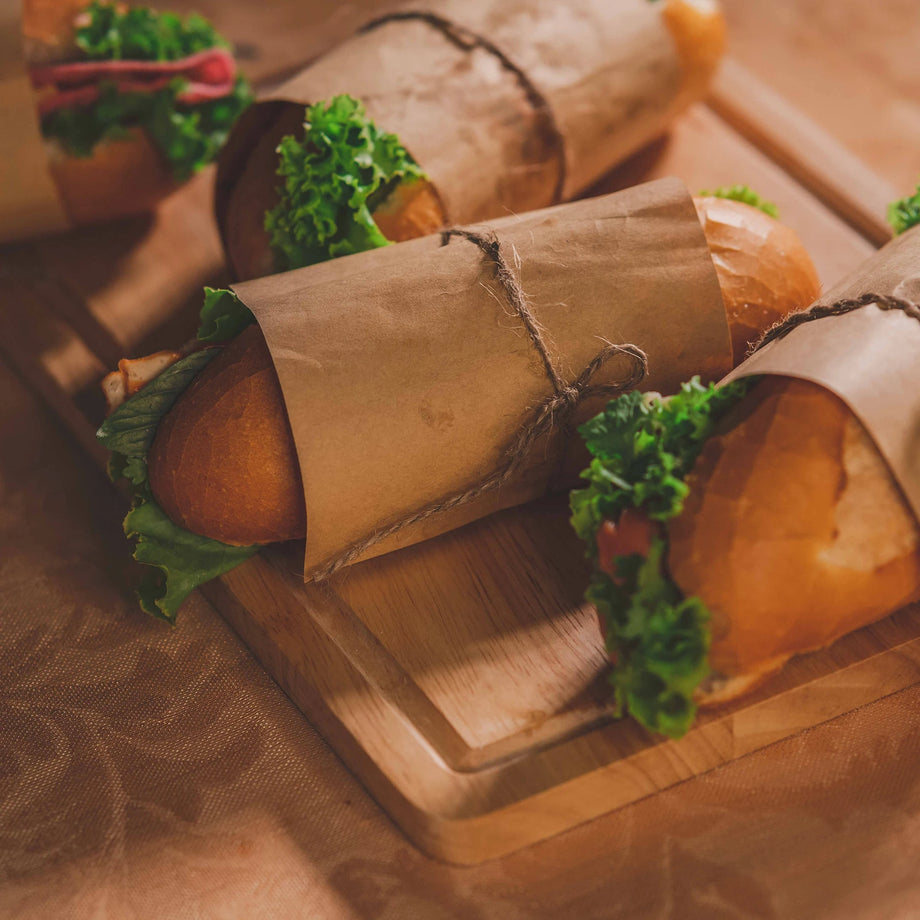
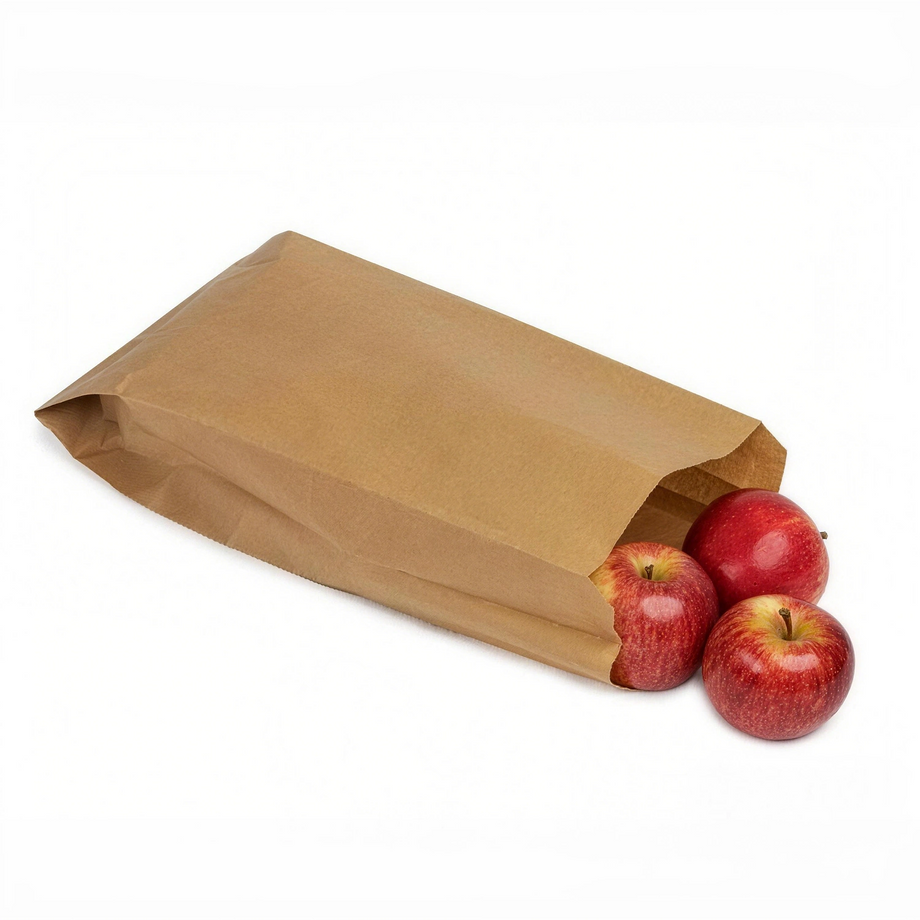
Unbleached kraft is the default for sacks, butcher wrap and outer bags: it is brown, usually stronger at the same grammage and cheaper to make, because it skips the bleaching stages. Choose bleached kraft when the pack needs a white print surface. BfR XXXVI permits both fibre types for food contact.
Key takeaways
- Unbleached kraft is usually stronger at the same grammage and cheaper to make; bleached gives a white print surface.
- BfR XXXVI permits both fibre types; colour alone does not decide food safety.
- Compare grades on a full data sheet, including Cobb and OBA, not grammage alone.
- State virgin or recycled fibre in the enquiry; recycled fibre for direct contact must pass the BfR annex.
Bleached vs unbleached kraft paper: which is better for food packaging?
Neither is safer by default. Germany's BfR Recommendation XXXVI on paper and board for food contact lists cellulose fibres and wood pulp, "bleached or unbleached", among its permitted raw materials [3]. What decides suitability for food is the whole grade: the fibre source, the chemicals added during papermaking and the test results on the finished paper.
So the choice comes down to four practical differences:
- Look. Unbleached kraft is brown and reads as natural. Bleached kraft is white and shows food, labels and colour print more cleanly.
- Printing. A white base gives brighter colours and sharper small text, such as ingredient lists. Brown paper suits one- or two-colour flexo designs.
- Strength. Bleaching removes the remaining lignin and can lower fibre strength [8], so at the same grammage unbleached kraft usually tests stronger in tear and tensile. That is why sack and butcher papers are mostly unbleached.
- Cost. Bleached kraft costs more to make: an industry price-reporting analysis puts the production cost of bleached kraft papers more than 20% above unbleached [9]. Market prices move with supply and demand and do not always follow that gap.
- Tests. White paper needs an optical brightener (OBA) result. Both need the same food-contact documents.
A quick rule for the common uses:
- Print in three colours or more, or small ingredient text: bleached.
- Direct contact with wet meat or fish: unbleached wet-strength kraft, with a barrier layer where the food is wet.
- Flour, sugar and other dry-goods sacks: high-strength unbleached, chosen on burst, tear and air permeability.
- Outer packaging where a natural look is the point: unbleached.
Table 1 sets Kaifeng's unbleached kraft paper beside its bleached kraft paper, using the values listed on the two product pages.
Table 1. Bleached and unbleached kraft: values listed on Kaifeng product pages
| Property | Unbleached kraft | Bleached kraft | How to read it |
|---|---|---|---|
| Grammage | 30–98 g/m² | 20–120 g/m² | Bleached covers lighter wraps and heavier bag paper |
| Thickness | 45–150 µm | 42–170 µm | Varies with grammage |
| Moisture | 7.0% (+2/−1) | 7.0% (+2/−1) | Affects curl and runnability |
| Water absorption (Cobb) | ≤ 40 g/m² | ≤ 60 g/m² | Lower means less water taken up |
| Smoothness | ≥ 15 s | ≥ 15 s (one side), ≥ 10 s (other side) | Affects print quality |
| Optical brightener | Negative | Negative | Confirm with a test report |
| Odour | ≤ 1 | < 1 | Low taint risk with fatty or delicate food |
Values as listed on the Kaifeng product pages in November 2026. For sack and bag use, Kaifeng's unbleached kraft is also listed with tensile strength of MD ≥ 33–105 and CD ≥ 15–67 N/15 mm, tear of MD ≥ 100–950 mN, burst of ≥ 100–350 kPa and air permeability of ≤ 5 µm/Pa·s, each varying with grammage.

What is the difference between bleached and unbleached kraft paper?
Both start from the same kind of pulp. Kraft paper is made from chemical pulp cooked in the kraft, or sulphate, process, which is the main chemical pulping process worldwide because of the strength of the pulp it gives [4]. Cooking leaves some lignin in the fibre and darkens it: unbleached kraft pulp has a brightness below 30% ISO [4]. Bleaching removes or oxidises that remaining lignin, and fully bleached pulp reaches 88% ISO or higher [4]. In European pulp production, elemental-chlorine-free (ECF) bleaching with chlorine dioxide stages is common practice, and totally chlorine-free (TCF) sequences are also used [4].
Pulp brightness figures from the EU reference document on pulp and paper production [4]. Bleaching removes or oxidises the lignin left after cooking.
For a buyer, three consequences matter more than the chemistry:
- Colour and brightness. Bleached paper gives a white base, so check whether the supplier adds optical brighteners to raise the whiteness, and check the test result.
- Strength data. Bleached and unbleached grades are different papers, so an unbleached strength figure does not carry across to a bleached grade at the same grammage.
- Surface. Both can be machine-glazed or calendered. Smoothness and absorbency, not colour, decide how well the paper runs on a printing press or takes adhesive in bag-making.
Colour says nothing about food safety on its own: a brown sheet made with unsuitable additives is worse for food contact than a white one made under good manufacturing practice with test evidence behind it.
Which kraft paper roll specifications matter for food use?
Seven properties cover most food applications, and each has a standard test that a specification sheet should name. Table 2 shows what each one tells you.
Table 2. Kraft roll specifications and test methods
| Property | Usual test method | Why it matters for food packaging | Write in the enquiry |
|---|---|---|---|
| Grammage | ISO 536 | Sets cost per square metre and stiffness | Target and tolerance, e.g. 70 g/m² ± 4% |
| Tensile and stretch | ISO 1924-2 | Runnability on wrapping and bag machines | Minimum MD and CD values |
| Tear and burst | ISO 1974, ISO 2758 | Resistance to bone, edge and corner damage | Minimum values for your use |
| Water absorption (Cobb) | ISO 535 | How the paper behaves with moist food and water-based inks | Maximum g/m² and test time |
| Air permeability | ISO 5636 series | Filling speed for flour and sugar sacks | Range, with the method part |
| Optical brightener | EN 648 | Whether brighteners can transfer to food | Result, with assessment level |
| Odour | Sensory test | Taint risk with fatty or delicate food | Maximum rating and method |
Methods as listed in the Cepi-CTS property list [5]; EN 648 as named in BfR XXXVI [3].
Grammage alone does not describe a grade. Two 70 g/m² papers can differ widely in Cobb value and tear strength, so compare the whole data sheet. When the data sheets come back, read each line of the spec sheet the same way for every supplier.
Cobb is the value most often missed. It measures how much water the paper absorbs over a set time; for paper, a 60-second test (Cobb60) is common [5]. Kaifeng's unbleached grade is listed at a Cobb value of 40 g/m² or less, and the bleached grade at 60 g/m² or less. For wrapping moist meat or fish, a lower Cobb value means less wicking. For water-based printing, some absorbency helps the ink set.
The unbleached Cobb line from Table 1. Compare it only with a figure from the same method and test time.
Optical brighteners matter mostly for white paper. BfR XXXVI states that brighteners must not transfer to food and sets EN 648 assessment level 5 as the benchmark [3]. A negative OBA result on a bleached grade answers that question directly, provided the report names the method.
Comparing bleached and unbleached kraft reels?
Send your reel width, grammage and food application. We quote both grades at that grammage, so you can compare like for like.
Kraft papers from Kaifeng
Virgin or recycled kraft for direct food contact?
For paper that touches food directly, state in the enquiry whether the grade must be virgin fibre. If recycled fibre is acceptable, it has to meet the BfR recycled-fibre annex. That annex excludes recovered paper of sort 5.01 under EN 643 and paper from household and mixed packaging waste, and allows some other sorts only for paper that is not used for direct food contact or primary packaging [3].
The annex also sets limits for substances that can come in with recovered paper, including phthalates, benzophenone and bisphenol S, and states that there should be no detectable transfer of mineral oil aromatic hydrocarbons (MOAH) [3]. For dry foods with a large surface area, such as flour, sugar or rice, it notes that these substances can move through the gas phase, which an extra inner bag or a barrier can compensate for [3].
Kraft rolls sold for parcels and void fill are made for packing goods, and their labels say nothing about food contact. For a food-contact grade, three lines settle the fibre question: virgin, recycled or a blend; for recycled fibre, the recovered paper sorts and the annex tests run; and whether the paper is for direct contact or outer packaging only.
Which kraft paper suits which food?
Match the paper to the food's moisture, fat and handling. Table 3 is a starting point, built from the property table above and the BfR notes on dry foods; confirm each choice with trials on your own line.
Table 3. Kraft paper type by food application
| Food or use | Usual choice | Extra checks or documents | Kaifeng grade |
|---|---|---|---|
| Fresh meat and fish wrap | Unbleached or wet-strength kraft, often with a barrier | Wet strength, Cobb, barrier layer declaration | High Wet Strength Kraft Paper |
| Bread and bakery bags | Bleached for print, or unbleached | Print set-off, OBA result | Bleached or Unbleached Kraft Paper |
| Flour, sugar and grain sacks | High-strength unbleached | Burst, tear, air permeability, MOAH if recycled | High-strength Kraft Paper |
| Fruit and vegetable wraps and liners | Wet-strength kraft | Wet tensile strength | High Wet Strength Kraft Paper |
| Takeaway and grocery bags | Bleached for brand print, or unbleached | Tensile, handle adhesion, print | Bleached or Unbleached Kraft Paper |
| Tray and box liners for dry food | Either | Odour, OBA result | Bleached or Unbleached Kraft Paper |
Plain kraft paper is not a grease barrier. For burgers, fried food and pastries, a greaseproof grade or a coated paper does that job, and its documents differ. If you need one, see how to choose a greaseproof paper manufacturer.
What changes when kraft paper is wet-strengthened, coated or waxed?
Each added treatment brings its own documents. The base paper's declaration does not cover a coating that was applied later.
Wet strength. Wet-strength agents keep paper intact when wet, which matters for meat, fish and produce with high moisture. BfR XXXVI lists them with limits on the finished paper: no more than 1.0 mg formaldehyde per dm² in the extract for urea- and melamine-formaldehyde resins, and 1.5 mg glyoxal per dm² for glyoxal [3]. For epichlorohydrin-based resins, 1,3-dichloro-2-propanol must not be detectable in the cold water extract [3]. The data sheet should name the wet-strength agent the grade uses, with the matching test result.
PE coating. In a paper and polyethylene combination, the plastic layer must comply with Regulation (EU) No 10/2011, which also requires a written declaration of compliance for plastic materials [6]. The paper itself has no EU specific measure, so it is covered by the general rules of Regulation (EC) No 1935/2004 [1].
Wax. BfR XXXVI refers wax and paraffin treatments to Recommendation XXV [3]. The wax needs its own evidence as well as the paper.
PFAS. If the roll will become food-contact packaging placed on the EU market, Article 5 of the Packaging and Packaging Waste Regulation has applied PFAS limits since 12 August 2026, including 25 ppb for any single PFAS and 250 ppb for the sum of PFAS by targeted analysis [7]. The limits apply to the packaging, whatever the paper type, so the evidence is a third-party PFAS report for the specific grade.
Which documents should come with food-contact kraft paper rolls?
Ask for five documents with the quotation, not after the first order:
- Declaration of compliance referring to Regulation (EC) No 1935/2004, naming the grade and the conditions of use: food type, temperature and contact time [1].
- Good manufacturing practice under Regulation (EC) No 2023/2006, shown through the supplier's documented quality assurance system [2].
- BfR XXXVI test report with the edition date, if you sell into Germany or your customers ask for it [3].
- OBA test result, especially for bleached paper.
- Third-party PFAS report for the specific grade, if the paper becomes packaging in the EU.
Certificates support these documents but do not replace them, and their scopes are often narrower than a supplier's product list. Kaifeng Paper, for example, holds BRCGS Packaging Materials certification, Grade A, with a scope limited to paper rolls for direct food-contact packaging, and ISO 22000:2018 for food packaging base paper. To check any supplier's certificates against public registers, use the checks before buying from a food packaging paper manufacturer in China.
How to specify a kraft paper roll order
A precise order avoids rolls that do not fit the machine. List these fields:
- Type: bleached or unbleached, virgin or recycled.
- Grammage and tolerance.
- Reel width, and the trim tolerance.
- Core inner diameter, for example 76 mm, and core material.
- Outer diameter or reel length, with the maximum your unwind stand takes.
- Winding direction: printed or glazed side in or out.
- Splices: maximum per reel and how they are marked.
- Packing: reels per pallet, moisture-proof wrapping, and labels with grade and lot number.
Regulation 1935/2004 requires traceability of food-contact materials at all stages [1]. A lot number on each reel label links a delivery to the paper's production records.
Send your kraft roll specification
To price both for your line, send your kraft roll specification for a quote with your width, grammage and food application.
- Tell us the type: bleached or unbleached, and the food application.
- Add grammage and tolerance, reel width, core, outer diameter and winding direction.
- We quote bleached or unbleached kraft paper rolls to that specification.
FAQs
What is a kraft paper roll used for in food packaging?
In food packaging, kraft rolls are converted into:
- butcher and deli wrapping paper;
- bread and bakery bags;
- flour, sugar and grain sacks;
- tray and box liners;
- takeaway and grocery bags.
Converters print, slit or form the paper on their own lines, so they buy it as reels of a set width and grammage.
What kind of paper is kraft paper?
Kraft paper is made from chemical wood pulp cooked in the kraft, or sulphate, process. It is the main chemical pulping process worldwide because the pulp it gives is strong, which suits wrapping, bag and sack paper. Unbleached kraft is brown. Bleached kraft has gone through extra stages that remove the remaining lignin to give a white sheet.
Is kraft paper safe for food contact?
It depends on the grade and its documents, not on its colour. Ask for a declaration of compliance referring to Regulation (EC) No 1935/2004 with the conditions of use, a BfR XXXVI test report for German customers, and an OBA result. Recycled kraft also needs evidence against the BfR recycled-fibre limits before it touches food directly.
Is unbleached kraft paper stronger than bleached?
Usually, at the same grammage. Bleaching removes residual lignin and can lower fibre strength, so unbleached kraft generally tests higher in tear and tensile, which is why sack and butcher papers are mostly unbleached. Pulp, refining and the paper machine still matter, so compare the actual values of the grades you are offered.
Does white kraft paper contain optical brighteners?
Some white papers do and some do not. BfR XXXVI requires that optical brighteners do not transfer to food, judged by the EN 648 test, so the OBA result on the exact grade settles it. Both Kaifeng kraft grades are listed as OBA negative on their product pages.
Can recycled kraft paper touch food directly?
Only if it meets the BfR XXXVI recycled-fibre annex. That rules out some recovered paper sources for direct contact and sets limits for substances such as phthalates and bisphenol S. Kraft rolls sold for parcels and void fill, whether labelled recycled or imitation, are sold for packing goods, so check the fibre and the documents before using them with food.
Where can I buy kraft paper rolls for food packaging in bulk?
For a few rolls, packaging distributors stock standard widths. For pallet quantities, set widths or printing, buy from a paper manufacturer or converter and send a specification: type, grammage, width, core, diameter, food use and the documents you need. Trial the paper on your own line before the first full order.
Compliance note: whether a regulation applies depends on the final use of the packaging and on the competent authority in each market. Parameters quoted from Kaifeng product pages are subject to Kaifeng's current specification sheets and test reports.
Sources
- European Parliament and Council. "Regulation (EC) No 1935/2004 on materials and articles intended to come into contact with food". EUR-Lex, 2004. https://eur-lex.europa.eu/eli/reg/2004/1935/oj/eng Accessed Nov 2026.
- European Commission. "Commission Regulation (EC) No 2023/2006 on good manufacturing practice for materials and articles intended to come into contact with food". EUR-Lex, 2006. https://eur-lex.europa.eu/eli/reg/2006/2023/oj/eng Accessed Nov 2026.
- German Federal Institute for Risk Assessment (BfR). "XXXVI. Paper and board for food contact" (as of 01.10.2026). BfR, 2026. https://empfehlungen.bfr.bund.de/recommendations/360/pdf?locale=en Accessed Nov 2026.
- European Commission, Joint Research Centre. "Best Available Techniques (BAT) Reference Document for the Production of Pulp, Paper and Board". Publications Office of the European Union, 2015. https://bureau-industrial-transformation.jrc.ec.europa.eu/reference/production-pulp-paper-and-board Accessed Nov 2026.
- Cepi-CTS. "Handbook 5:1 List of properties for which samples are provided and their indicative ranges" (Rev. 45). Cepi, 2026. https://www.cepi.org/wp-content/uploads/2026/05/HB51-Properties-list.pdf Accessed Nov 2026.
- European Commission. "Commission Regulation (EU) No 10/2011 on plastic materials and articles intended to come into contact with food". EUR-Lex, 2011. https://eur-lex.europa.eu/eli/reg/2011/10/oj/eng Accessed Nov 2026.
- European Parliament and Council. "Regulation (EU) 2025/40 on packaging and packaging waste". EUR-Lex, 2025. https://eur-lex.europa.eu/eli/reg/2025/40/oj/eng Accessed Nov 2026.
- Lin et al. "Correlation analysis for fiber characteristics and strength properties of softwood kraft pulps from different stages of a bleaching fiber line". BioResources 9(3), 5024–5033, 2014. https://bioresources.cnr.ncsu.edu/BioRes_09/BioRes_09_3_5024_Lin_HLM_Influence_Fiber_Charact_Strength_Proper_5619.pdf Accessed Nov 2026.
- Fastmarkets. "Key insights on US bleached and unbleached kraft paper markets: How sustainability goals are impacting demand". Fastmarkets. https://www.fastmarkets.com/insights/key-insights-on-us-bleached-and-unbleached-kraft-paper-markets Accessed Nov 2026.