
Medical Packaging Paper vs. Medical-grade Tyvek
In regulated healthcare environments, packaging materials directly affect sterility assurance, regulatory compliance, operational efficiency, and patient safety. Among the most widely used options, medical packaging paper and medical-grade Tyvek are often compared—but rarely understood in depth.
Having worked for years with medical device manufacturers, packaging engineers, and quality teams, I’ve seen how material selection can either streamline validation or quietly introduce long-term risks. This article breaks down the real-world differences between these two materials, focusing on structure, sterilization performance, microbial barrier reliability, sealing behavior, and decision-making criteria—not marketing claims.
Medical Packaging Paper vs. Tyvek: Key Structural Differences
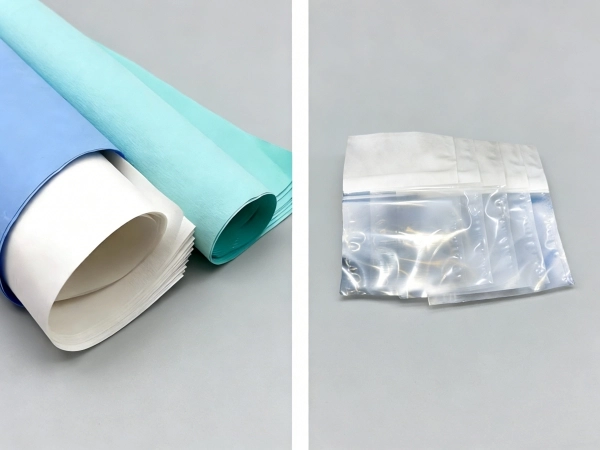
At their core, medical packaging paper and medical-grade Tyvek differ fundamentally in how they are made—and that difference drives almost every performance outcome downstream.
Medical packaging paper is typically produced from high-purity cellulose fibers, engineered to deliver controlled porosity. Fiber orientation, refining level, and calendering determine its air permeability and microbial barrier performance. Because it is fiber-based, paper naturally allows sterilant penetration while maintaining a physical barrier once sealed.
Medical-grade Tyvek, on the other hand, is a flash-spun high-density polyethylene (HDPE) material. Instead of fibers laid in a traditional web, Tyvek consists of randomly bonded, continuous filaments. This structure gives it exceptional tear resistance and durability, while maintaining permeability to gases used in sterilization.
From a structural standpoint:
• Paper relies on fiber network density to balance breathability and protection
• Tyvek relies on nonwoven filament bonding for strength and consistency
Neither structure is “better” in isolation—the difference becomes meaningful when matched to specific applications and sterilization methods.
Which Material Works Better for Medical Sterilization?
Sterilization compatibility is often the first technical filter in material selection, and it is where misconceptions are most common.
Medical packaging paper performs particularly well in:
• Steam sterilization (autoclave)
• Ethylene oxide (EO) processes
Its cellulose structure tolerates moisture and temperature when properly specified, and its permeability allows sterilants to pass efficiently. However, paper can show strength degradation after aggressive gamma irradiation or repeated cycles.
Medical-grade Tyvek excels in:
• EO sterilization
• Gamma and e-beam sterilization
Because HDPE is not affected by radiation in the same way as cellulose, Tyvek maintains mechanical integrity after irradiation. That said, Tyvek is not suitable for high-temperature steam sterilization, as excessive heat can distort or shrink the material.
In practice:
• Steam → paper is usually the safer choice
• Radiation → Tyvek offers better stability
• EO → both can work, depending on package design
Selecting the wrong material for the sterilization method can complicate validation and shorten shelf life—an expensive mistake.
How Reliable Is the Microbial Barrier Over Time?
A medical package does not just need to be sterile after sterilization—it must remain sterile throughout storage, transport, and handling.
Medical packaging paper provides a predictable microbial barrier when produced to medical standards. Its pore structure blocks bacteria while allowing air exchange. However, paper is more sensitive to:
• Mechanical abrasion
• Excessive humidity
• Folding or creasing during transport
Medical-grade Tyvek offers a highly robust microbial barrier, especially in demanding logistics environments. Its resistance to tearing and puncture reduces the risk of accidental breaches during handling, making it popular for high-risk or high-value medical devices.
That said, Tyvek can be vulnerable to seal-related failures if incorrect temperatures or pressures are used. A strong material does not compensate for poor sealing parameters.
Long-term reliability depends not only on material choice, but on storage conditions, package design, and process control.
Sealing Performance on Medical Packaging Lines
From a production perspective, sealing behavior can make or break operational efficiency.
Medical packaging paper generally has:
• A wider sealing window
• More forgiving heat-seal behavior
• Easier integration with standard form-fill-seal equipment
This makes paper attractive for manufacturers running high-speed packaging lines or managing frequent product changeovers.
Medical-grade Tyvek, while extremely strong, has:
• A narrower sealing window
• Greater sensitivity to temperature and dwell time
• Higher risk of seal creep if parameters drift
As a result, Tyvek packaging often requires tighter process control, more extensive seal validation, and closer QA oversight.
In facilities where process stability is high, this is manageable. In environments prioritizing flexibility and throughput, paper-based systems often prove more efficient.
How to Choose Between Medical Packaging Paper and Tyvek
The most reliable way to choose between medical packaging paper and medical-grade Tyvek is to evaluate risk profile rather than material reputation.
Medical packaging paper is often the better choice when:
• Steam sterilization is required
• Cost control and sustainability matter
• High-speed packaging efficiency is a priority
• Devices present low to moderate puncture risk
Medical-grade Tyvek is often preferred when:
• Radiation sterilization is mandatory
• Devices are sharp, heavy, or high-value
• Packaging must survive harsh logistics conditions
• Long shelf life under variable environments is required
Ultimately, neither material is universally superior. The best-performing packaging systems are those where material, sterilization method, sealing process, and regulatory requirements are aligned from the start.